LEADING COPPER NICKEL 90/10 & 70/30 COLLAR MANUFACTURER & EXPORTER — ISO 9001:2015 CERTIFIED
Manufacturer, Exporter & Supplier of Copper-Nickel 90/10 & 70/30 Collars
March 3, 2025 10 min read Sunflex Metalloy Engineering Team
Few decisions cause as much confusion during procurement of Copper Nickel Stub End Collars and Welding Neck Collars as the choice of governing dimensional standard. American, European and international specifications each define stub end and collar geometry slightly differently — and specifying the wrong one, or assuming two standards are interchangeable when they aren't, can lead to costly delays at the fabrication stage. As a Copper Nickel Stub End Manufacturer supplying projects across multiple continents, Sunflex Metalloy is asked to reconcile these standards on almost every international order. Here is the complete breakdown.
ASME B16.9 is the primary American standard governing factory-made butt-welding fittings, including the long-pattern Copper Nickel Stub End. Long pattern stub ends feature an extended face-to-toe hub length, providing a smoother, more gradual weld transition and greater tolerance to pipe misalignment during field erection. This makes ASME B16.9 long-pattern stub ends the default choice for high-pressure applications, naval shipbuilding projects subject to NAVSEA T9074, and any piping system experiencing significant vibration or cyclic loading, where the extended hub reduces stress concentration at the weld root.
MSS SP-43 defines the short-pattern Copper Nickel Stub End, offering a significantly reduced overall face-to-toe length compared to ASME B16.9 while retaining the same lap face diameter, radius and sealing performance. This makes MSS SP-43 short-pattern stub ends the economical, space-efficient choice for retrofit projects, congested piping arrangements, and any application where reduced material weight and installed footprint are priorities — without any compromise to joint sealing reliability.
In Europe and in much of the international marine and offshore sector, DIN 86037 and its close counterpart EEMUA 145 govern what is more commonly termed the Copper Nickel Welding Neck Collar — functionally very similar to the ASME/MSS stub end concept, but with its own distinct hub proportions, face preparation and terminology conventions. DIN 86037 collars are especially prevalent on shipyard specifications originating from European classification societies and are frequently cross-referenced against ASME B16.5 flange face dimensions for compatibility with American-pattern loose backing flanges.
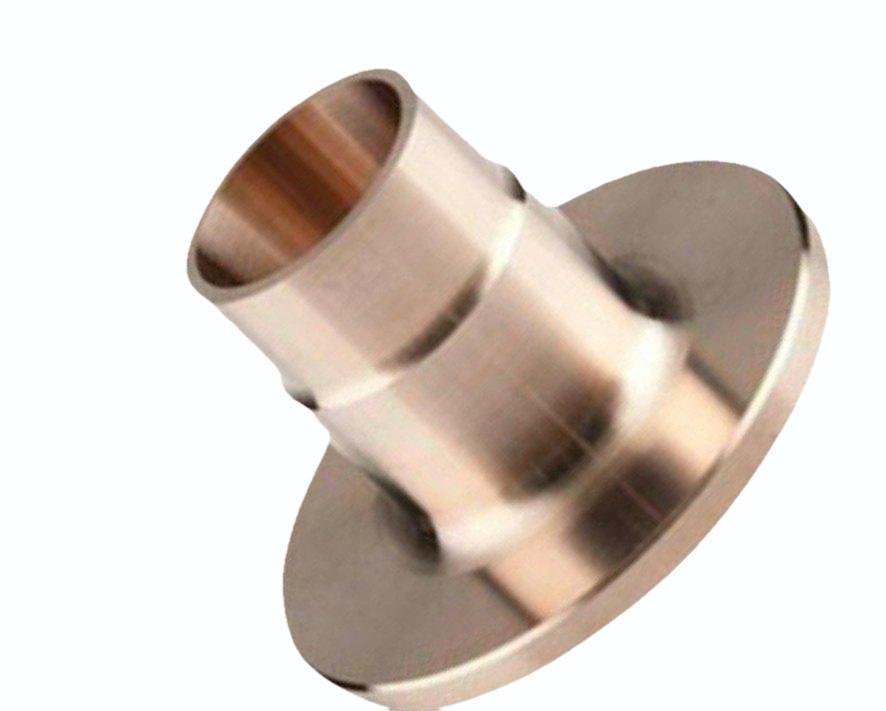
While all three standards achieve the same functional outcome — a wetted CuNi hub that mates with a loose backing flange — the actual hub lengths, lap face radii and tolerance bands differ between ASME B16.9, MSS SP-43 and DIN 86037/EEMUA 145. This is precisely where an experienced Copper Nickel Collar Manufacturer adds value: rather than assuming a stub end manufactured to one standard will drop directly into a flange assembly designed to another, Sunflex Metalloy verifies flange face compatibility against the specific mating component before manufacture, and can supply comparative dimensional drawings on request.
For pressure classes above the range typically covered by standard ASME B16.9 stub ends, MSS SP-75 provides supplementary dimensional data for high-pressure long-pattern stub ends, commonly specified alongside ASME B16.9 on Class 1500, 2500 and higher-pressure Copper Nickel piping systems in offshore and power generation applications.
Regardless of which dimensional standard governs the stub end or collar geometry, the material itself — CuNi 90/10 or CuNi 70/30 — must still comply with the applicable material standard (typically ASTM B466 for seamless pipe or forgings) and be supplied with an EN 10204 3.1 Mill Test Certificate. This certificate, covering chemical composition, mechanical properties and dimensional inspection, is the common thread across ASME, MSS, DIN and EEMUA-governed projects, and should always accompany the shipment regardless of which dimensional standard was specified.
For EPC contractors managing projects that draw on both American and European engineering conventions — increasingly common on international shipbuilding and offshore contracts — the safest approach is to specify the dimensional standard explicitly for each line item (rather than relying on a generic "stub end" or "collar" callout) and to confirm flange face compatibility between the stub end/collar standard and the mating flange standard before releasing fabrication drawings. Sunflex Metalloy's engineering team routinely supports this cross-referencing process for multi-standard bills of materials.
They serve the same functional purpose — a CuNi hub welded to pipe and used with a loose backing flange — but DIN 86037 and ASME B16.9 define different hub lengths, lap face radii and tolerances. They are not dimensionally identical and should not be assumed interchangeable without checking the specific drawings.
MSS SP-75 is used for higher pressure classes (typically Class 1500 and above) where the standard ASME B16.9 dimensional range does not extend, and is commonly specified alongside ASME B16.9 for the applicable higher-pressure sizes.
Yes — regardless of the dimensional standard, the CuNi material itself is certified against its material standard (typically ASTM B466) with an EN 10204 3.1 Mill Test Certificate covering chemistry, mechanical properties and dimensional inspection.
Yes. In addition to ASME B16.9, MSS SP-43, MSS SP-75, DIN 86037 and EEMUA 145, Sunflex Metalloy manufactures Stub End Collars and Welding Neck Collars to custom purchaser drawings where a project specification requires dimensions outside the standard tables.
Our engineering team is available to assist with collar selection, standard interpretation and custom specifications.
Contact Our Team