Marine Engineering

LEADING COPPER NICKEL 90/10 & 70/30 COLLAR MANUFACTURER & EXPORTER — ISO 9001:2015 CERTIFIED
Manufacturer, Exporter & Supplier of Copper-Nickel 90/10 & 70/30 Collars
February 8, 2025 9 min read Sunflex Metalloy Engineering Team
One of the most frequent questions we receive as a Copper Nickel Collar Manufacturer, Supplier and Exporter is deceptively simple: should this project specify CuNi 90/10 or CuNi 70/30 for its Welding Neck Collars, Stub End Collars and Composite Flanges? Both are Copper-Nickel alloys, both resist seawater corrosion far better than steel or stainless steel, and both are readily available from Sunflex Metalloy in every collar configuration we manufacture — yet the two grades are not interchangeable, and choosing incorrectly can mean paying for performance a project doesn't need, or under-specifying a system that will see aggressive service conditions. This guide breaks down the real differences between UNS C70600 and UNS C71500 collars so you can specify with confidence.
CuNi 90/10 (UNS C70600, CW352H, DIN CuNi10Fe1Mn) contains a nominal 9–11% nickel content with 1.0–1.8% iron and up to 1.2% manganese, balance copper. CuNi 70/30 (UNS C71500, CW354H, DIN CuNi30Mn1Fe) steps the nickel content up to 29–33%, with a lower iron content (0.4–1.0%) and up to 1.0% manganese. The added nickel is the single biggest driver of the performance differences between the two grades — and, unsurprisingly, of the price difference as well, since nickel is a significantly more expensive raw material input than copper.
CuNi 70/30 is the stronger of the two alloys across every standard mechanical property: a minimum tensile strength of roughly 380 MPa (55 ksi) versus 275 MPa (40 ksi) for CuNi 90/10, and a minimum yield strength of around 170 MPa (25 ksi) versus 105 MPa (15 ksi). Both grades share a comparable minimum elongation of around 30%, meaning ductility and formability are broadly similar — the difference lies almost entirely in ultimate strength and resistance to deformation under pressure, which is why CuNi 70/30 Stub End Collars and Welding Neck Collars are frequently specified for higher pressure classes and higher-velocity flow applications.
Both alloys form a protective, adherent oxide film in seawater that provides excellent long-term corrosion resistance, and both exhibit the biofouling resistance that makes Copper-Nickel the material of choice for marine piping. The key practical difference is erosion-corrosion resistance at higher flow velocities: CuNi 70/30 tolerates higher seawater flow rates (commonly cited around 4.5–5 m/s versus roughly 3–3.5 m/s for CuNi 90/10) before erosion-corrosion becomes a design concern. This makes CuNi 70/30 Collars the preferred choice for pump discharge lines, condenser water boxes and other high-velocity locations, while CuNi 90/10 remains entirely adequate — and more cost-effective — for the majority of general seawater piping runs.
CuNi 90/10 Welding Neck Collars and Stub End Collars dominate general seawater cooling systems, ballast piping, fire-main systems, and the bulk of commercial shipbuilding and desalination plant piping where flow velocities remain moderate. Its lower nickel content makes it the more economical specification wherever service conditions don't specifically demand the extra strength or erosion resistance of CuNi 70/30 — and for most marine projects, this is the majority of the piping system.
CuNi 70/30 is reserved for the more demanding sections of a system: condenser tube headers and water boxes, high-velocity pump discharge piping, naval vessel piping systems governed by MIL-T-16420, and any application where the additional mechanical strength justifies the higher material cost. Many NORSOK-compliant offshore Norwegian Continental Shelf projects also default to CuNi 70/30 for critical seawater lift and fire-water systems due to its superior strength margin.
Because nickel content is the primary cost driver, CuNi 70/30 collars typically carry a meaningful cost premium over equivalent CuNi 90/10 components — often in the range of 20–40% depending on prevailing nickel market prices. For large projects with hundreds of Welding Neck Collars, Stub End Collars or Composite Flanges, correctly segmenting which sections of the piping system genuinely require CuNi 70/30 versus which can safely use CuNi 90/10 can represent a significant material cost saving without compromising system integrity.
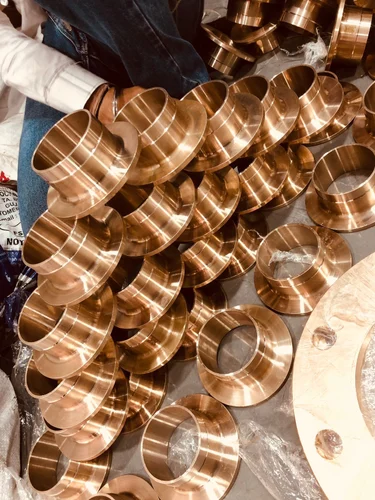
As a specialist Copper Nickel Stub End Manufacturer, Sunflex Metalloy stocks and manufactures every collar type in our range — Welding Neck Collar, Short & Long Weld Neck Collar, Stub End Collar, Short & Long Stub End Collar and Composite Flange — in both CuNi 90/10 and CuNi 70/30, so project teams can source a mixed-grade bill of materials from a single, ISO 9001:2015 certified supplier with consistent EN 10204 3.1 documentation across the entire order.
Not necessarily 'better' — CuNi 70/30 offers higher strength and higher flow-velocity tolerance, but at a meaningful cost premium. For the majority of general seawater piping, CuNi 90/10 provides fully adequate corrosion resistance and biofouling protection at a lower cost, making grade selection a question of matching alloy to service condition rather than simply choosing the 'premium' option.
Yes, CuNi 90/10 and CuNi 70/30 components are commonly welded together in the same piping system using a compatible CuNi filler metal, and this is standard practice where different sections of a system have different service requirements.
CuNi 90/10 (UNS C70600) contains approximately 9-11% nickel, while CuNi 70/30 (UNS C71500) contains approximately 29-33% nickel — the higher nickel content in CuNi 70/30 is the primary driver of its increased strength, erosion resistance and cost.
NORSOK and MIL-T-16420 do not universally mandate one grade — both standards permit CuNi 90/10 and CuNi 70/30 depending on the specific application and service velocity defined in the project's piping class specification, so the applicable grade should be confirmed against the project's specific data sheets.
Our engineering team is available to assist with collar selection, standard interpretation and custom specifications.
Contact Our Team