LEADING COPPER NICKEL 90/10 & 70/30 COLLAR MANUFACTURER & EXPORTER — ISO 9001:2015 CERTIFIED
Manufacturer, Exporter & Supplier of Copper-Nickel 90/10 & 70/30 Collars
April 17, 2025 9 min read Sunflex Metalloy Engineering Team
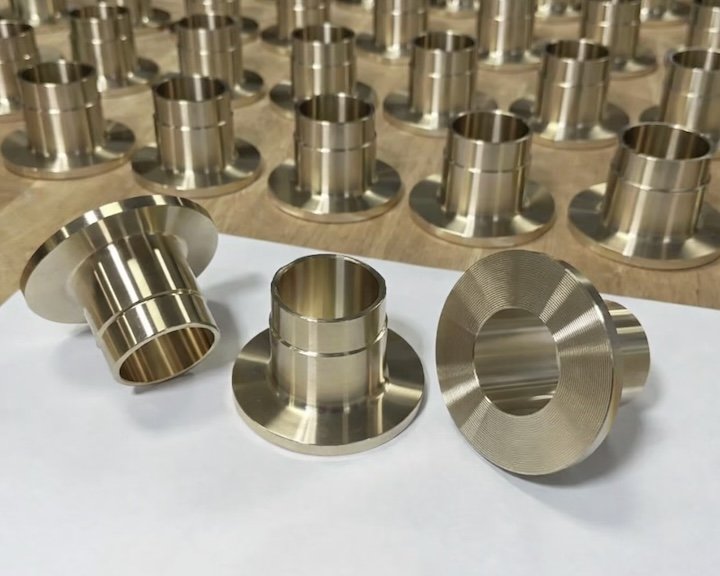
Offshore oil and gas platforms — whether fixed jackets, semi-submersibles, FPSOs or subsea pipeline tie-ins — subject piping systems to some of the harshest combined conditions in industrial engineering: continuous seawater immersion or splash-zone exposure, high mechanical loading, vibration, and in many cases explicit national or classification-society standards that go well beyond generic corrosion-resistant material selection. Copper Nickel Welding Neck Collars, Stub End Collars and Composite Flanges are specified extensively across offshore seawater lift, firewater, cooling and utility piping precisely because CuNi 90/10 and CuNi 70/30 satisfy both the corrosion-performance and the compliance requirements these projects demand.
On a typical offshore installation, Copper-Nickel piping — and by extension Copper Nickel Welding Neck Collars and Stub End Collars — is found in seawater lift systems supplying cooling water to process equipment, firewater ring mains, ballast systems on floating platforms, and utility seawater distribution. Composite Flange assemblies are particularly common at equipment nozzle connections, where the CuNi wetted stub end interfaces with a carbon steel or duplex stainless steel backing flange bolted to the equipment.
NORSOK M-630 is the material data sheet standard widely referenced on Norwegian Continental Shelf offshore projects, and it explicitly covers Copper-Nickel piping components including collars and stub ends. Compliance under NORSOK typically requires documented chemical composition and mechanical property verification against the relevant material standard (commonly ASTM B466), full material traceability, and in many cases third-party inspection. Sunflex Metalloy manufactures Welding Neck Collars, Stub End Collars and Composite Flanges to NORSOK-referenced material and documentation requirements, supporting Norwegian and broader North Sea offshore project specifications.
Where offshore platforms or support vessels fall under military or defence procurement — including naval logistics support vessels and certain strategic offshore assets — MIL-T-16420 governs Copper-Nickel pipe and tube material requirements, while NAVSEA T9074 sets broader welding, fabrication and quality assurance requirements for naval piping systems. Both standards place additional emphasis on weld procedure qualification, non-destructive examination and documented material traceability compared to standard commercial offshore specifications — requirements that a specialist Copper Nickel Collar Manufacturer should be equipped to support as standard practice, not as a costly project-specific exception.
While UNS C70600 (CuNi 90/10) and UNS C71500 (CuNi 70/30) cover the vast majority of offshore Copper-Nickel collar specifications, some offshore and naval projects specify variant grades such as C71640 (a modified CuNi 70/30 with enhanced properties for specific naval applications) or C72200 for particular high-strength requirements. Sunflex Metalloy can source and manufacture these variant grades on request, subject to project-specific lead time and minimum order quantity confirmation.
Offshore structures are almost universally protected by impressed current or sacrificial anode cathodic protection systems, and Copper-Nickel piping components must be electrically and metallurgically compatible with this protection scheme. Copper-Nickel alloys are broadly compatible with standard offshore cathodic protection systems, though care must be taken at galvanic couples where CuNi collars interface with carbon steel backing flanges or structural steelwork — a consideration Sunflex Metalloy's engineering team can advise on during the collar and Composite Flange specification stage.
Offshore seawater lift and cooling systems are particularly vulnerable to biofouling-driven flow restriction, given the continuous seawater intake and the difficulty of accessing subsea or splash-zone piping for maintenance. The natural biofouling resistance of Copper-Nickel — including at Welding Neck Collar and Stub End Collar flanged joints — reduces the frequency of costly offshore intervention compared to steel or coated alternatives, a factor that increasingly informs material selection on new offshore developments.
As a Copper Nickel Collar Manufacturer, Supplier and Exporter with export experience across the Middle East, North Sea, West Africa and Asia-Pacific offshore markets, Sunflex Metalloy supports NORSOK, MIL-T-16420 and NAVSEA T9074 documentation requirements alongside standard EN 10204 3.1 Mill Test Certification, with third-party witness inspection available through Lloyd's Register, DNV, ABS and Bureau Veritas for classed offshore installations.
Requirements vary by project specification, but many NORSOK-referenced offshore projects do require third-party witness inspection of material testing and dimensional verification — Sunflex Metalloy supports this through Lloyd's Register, DNV, ABS and Bureau Veritas.
Composite Flange assemblies are used extensively in subsea and splash-zone piping, provided the backing flange material and any cathodic protection interface are correctly specified for the immersion environment — this should be confirmed with the platform's corrosion engineering team.
MIL-T-16420 is a material specification governing Copper-Nickel pipe and tube chemical and mechanical requirements, while NAVSEA T9074 is a broader fabrication, welding and quality assurance standard for naval piping systems — the two are frequently referenced together on naval and defence-related offshore projects.
Yes, every Welding Neck Collar, Stub End Collar and Composite Flange is supplied with full material traceability from certified CuNi billet through to the finished component, documented on the EN 10204 3.1 (or 3.2, on request) Mill Test Certificate.
Our engineering team is available to assist with collar selection, standard interpretation and custom specifications.
Contact Our Team